
Email personalization is easy to talk about and surprisingly hard to sustain.
Many teams start with good intentions: dynamic fields, segmented lists, and maybe even conditional content. But as programs grow, personalization often plateaus. Campaigns become harder to manage, data goes stale, and “personalized” emails start to feel generic again.
The issue isn’t creativity. It’s scale.
Real personalization only works when it’s built on data that can evolve over time. That data lives in your CRM, but how it’s collected, maintained, and activated determines whether personalization actually holds up as your email program grows.
Why Most Personalization Doesn’t Scale
A lot of personalization tactics break down as volume increases.
For example:
- Manually curated segments require constant upkeep
- One-off conditional rules multiply quickly
- Static data gets outdated almost as soon as it’s collected
These approaches might work for a handful of campaigns, but they don’t hold up across ongoing email programs.
What does scale is personalization rooted in CRM data. Fields that are structured, shared across systems, and updated as contacts progress.
Start with CRM Fields That Reflect Meaningful Differences
Not all data is useful for personalization.
To scale, CRM fields should answer questions like:
- What does this contact care about?
- Where are they in their decision process?
- What should they see next?
Fields that tend to work well include:
- Lifecycle or lead status
- Journey or funnel stage
- Industry or account type
- Product interest or solution focus
You don’t need dozens of fields. A small number of reliable, well-defined fields will outperform a complex setup built on incomplete data.
The challenge is that even well-defined CRM fields lose value if they aren’t kept current. Collecting everything up front creates friction but relying on one-time data capture limits how personalized an experience can become over time.
Use CRM Data to Personalize Programs, Not Just Emails
Personalization scales best when it shapes the overall experience, not just individual messages.
Instead of asking:
“How do I personalize this email?”
Ask:
“How should this personalized experience change over time?”
CRM data allows you to:
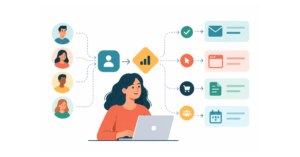
- Route contacts into different nurture paths
- Adjust messaging as their status changes
- Control timing, cadence, and CTAs automatically
This keeps personalization consistent across campaigns without creating endless variations.
Of course, this kind of experience-level personalization only works if the underlying CRM data stays current as contacts continue to engage.
How Progressive Data Collection Supports Scalable Personalization
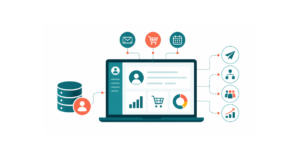
To support personalization at scale, data collection must be consistent and persistent. Instead of asking for everything at once, information should be gathered gradually across forms, landing pages, and interactions, and stored back in the CRM as it’s provided.
This approach keeps friction low while ensuring CRM data improves over time. As records become more complete, personalization becomes more relevant without requiring constant manual updates or program rebuilds.
What Scalable Personalization Looks Like in Practice
A progressive capture experience makes this concept tangible.
As someone interacts with a page, the experience adapts based on what’s already known and updates as new information is provided. The messaging changes, the content shifts, and the next step becomes clearer without requiring a long form or manual follow-up.
Behind the scenes, CRM fields are doing the work:
- Data is captured incrementally
- Records stay current
- Email programs and segments update automatically
This is personalization that grows with the relationship, not personalization that has to be rebuilt every time something changes.
We built an interactive progressive capture landing page that shows how personalization can evolve as data is collected — how messaging changes, how fields update, and how the experience adapts without asking for everything up front.
Explore the progressive capture experience to see how CRM data can power personalization across touchpoints, not just inside individual emails.
Measure Personalization by Progress, Not Just Engagement
At scale, success isn’t just about higher open or click rates.
CRM-driven personalization makes it possible to evaluate:
- How different segments move through the funnel
- Where engagement accelerates or stalls
- Which experiences support conversion and retention
When personalization is tied to CRM data, reporting reflects real outcomes and not just inbox activity.
What Scalable Personalization Really Requires
Real personalization isn’t about clever tokens or increasingly complex rules. It’s about using CRM data to create experiences that adapt naturally over time.
Start small:
- Choose a few CRM fields that matter
- Let those fields guide segmentation and automation
- Improve data gradually instead of all at once
That’s how personalization scales without overwhelming your team or your audience.
Want to see what scalable personalization looks like in action?
Explore how CRM-driven data and progressive capture can work together in the emfluence Marketing Platform by scheduling a demo.