
Marketing teams expect automation to make them more independent.
A marketer should be able to identify an audience, build a campaign, create a customer journey, make changes, launch it, and understand the results without opening a support ticket every time something changes.
For some organizations using Microsoft Dynamics 365 Customer Insights – Journeys, the reality can be more complicated.
The issue isn’t that marketers can’t use Dynamics 365 marketing tools. Microsoft has built extensive functionality for segmentation, journeys, personalization, consent management, analytics, and more.
The question is how much technical infrastructure sits behind those capabilities and who needs to manage it.
When everyday marketing execution depends on Dataverse configuration, security roles, permissions, CRM architecture, integrations, or administrative changes, marketers can find themselves relying on CRM administrators, IT teams, developers, or outside consultants more often than they expected.
That dependency has a cost, even when the technology itself is working exactly as designed.
The Real Question Isn’t Whether Dynamics 365 Can Do It
Dynamics 365 Customer Insights – Journeys is capable of supporting sophisticated marketing programs.
That’s not really the issue.
When evaluating a marketing platform, organizations often focus heavily on functionality:
- Can it build this segment?
- Can it automate this journey?
- Can it use this CRM data?
- Can it personalize this message?
Those are important questions. But marketers should ask another one:
Who on our team will actually be able to do it?
A feature that technically exists but routinely requires specialized knowledge or administrative assistance creates a very different operating model from one marketers can manage themselves.
That distinction becomes increasingly important as campaigns change faster, and marketing teams are expected to execute more with the same resources.
Where IT Dependency Can Enter the Dynamics Marketing Process
Not every Dynamics 365 marketing task requires IT involvement.
Marketers can perform plenty of day-to-day work independently once the environment is configured appropriately.
The friction tends to appear when marketing needs intersect with the underlying Dynamics and Dataverse environment.
Security Roles and Permissions
Access in Customer Insights – Journeys isn’t simply a matter of giving someone a login.
Dynamics uses security roles and access scopes to determine what users can see and do. Organizations may also customize those roles to match their own business requirements.
That gives organizations significant control over security and governance.
It also creates another layer that needs to be understood and maintained.
A marketer who suddenly can’t access a record, use a particular capability, or complete an action may not be able to solve the problem from within the marketing campaign itself.
The issue may sit within permissions, role configuration, record ownership, or business-unit structure.
At that point, marketing needs someone who understands the environment behind the campaign.
Dataverse Structure and CRM Configuration
Marketing campaigns don’t operate independently from the way Dynamics stores data.
Contacts, leads, accounts, opportunities, custom tables, relationships, fields, and other records in Dataverse determine what information marketers have available and how that information can be used.
That can be incredibly powerful.
It also means a marketing request can quickly become a CRM configuration question.
Suppose marketing wants to build a segment based on a piece of customer information that isn’t currently structured in a usable way.
The problem isn’t necessarily the segment builder.
Someone may first need to determine where that information belongs, how it relates to other records, who can access it, and how it should be maintained.
Marketing’s seemingly simple request has now crossed into CRM administration.
Business Units and Governance
Larger Dynamics environments may also use business units to control access to records and marketing capabilities.
That can be important for organizations with multiple divisions, brands, regions, or teams. But it introduces another consideration into campaign execution.
- Which records can a marketer access?
- Which audiences can a segment include?
- How should consent work across business units?
- Who owns the relevant records?
These are legitimate governance questions. They just aren’t necessarily questions marketers expect to answer when they’re trying to launch a campaign.
The Problem Isn’t IT. It’s the Bottleneck.
Marketing and IT should work together.
CRM administrators, developers, security teams, and technical partners play an important role in maintaining reliable systems, protecting customer data, and supporting the broader technology environment.
The problem starts when collaboration becomes dependency.
Small Changes Can Become Bigger Requests
Imagine marketing wants to launch a campaign for a new audience.
They discover that the CRM doesn’t currently capture one of the criteria they need.
Now someone needs to create or modify the appropriate field or structure.
- Permissions may need to be reviewed.
- The data needs to be populated.
- The marketer needs access to it.
- The segment needs to be tested.
None of those steps is inherently unreasonable.
But the campaign that marketing hoped to launch this week may now depend on someone else’s backlog.
Repeat that pattern across segmentation, automation, reporting, forms, integrations, and customer data, and marketing agility begins to suffer.
Technical Teams Have Their Own Priorities
Your CRM administrator isn’t sitting around waiting for marketing to need something.
Neither is IT.
They’re managing security, integrations, system updates, user requests, data quality, business processes, other departments, and potentially an entire Microsoft ecosystem.
Marketing requests compete with all of that.
The more frequently campaign execution requires technical intervention, the more marketing’s timeline becomes tied to resources it doesn’t control.
That’s the real operational concern.
What Should Marketers Be Able to Manage Themselves?
There’s no universal line between marketing and IT responsibilities.
Organizations have different security requirements, resources, CRM configurations, and levels of technical expertise.
But it’s worth defining where you want that line to be.
For many teams, marketers should ideally be able to handle routine activities such as:
- Building and modifying audiences
- Creating and editing emails
- Building forms and landing pages
- Creating automated journeys
- Adjusting campaign logic
- Using CRM fields for personalization
- Reviewing campaign performance
- Testing campaigns
- Responding to changes in customer behavior
- Launching routine campaigns
Technical support will still be necessary at times.
A new integration, major CRM change, custom data requirement, security issue, or unusual business process may absolutely justify involving IT or a CRM administrator.
The difference is whether technical involvement is the exception or part of the normal campaign-production process.
Marketer Independence Has Business Value
Ease of use is sometimes treated as a soft requirement when organizations evaluate marketing technology.
It shouldn’t be.
A platform that marketers can operate independently affects more than user satisfaction.
Campaigns Can Move Faster
Marketing opportunities don’t always arrive on the technology team’s schedule.
A competitor makes an announcement. A sales team needs support for a new initiative. An event changes. Customer behavior shifts. Leadership wants a campaign launched quickly.
The fewer technical dependencies involved in routine execution, the easier it is for marketing to respond.
Experimentation Becomes Easier
Testing requires iteration.
If changing a segment, adjusting workflow logic, or trying a new campaign approach requires technical assistance every time, marketers are naturally going to experiment less often.
When marketers can make those changes themselves, the cost of trying something new drops.
IT Gets Time Back, Too
Reducing marketing’s dependence on IT isn’t only good for marketing.
It can be good for IT.
Technical teams shouldn’t have to become the marketing department’s campaign-production desk.
Giving marketers tools they can operate independently allows IT and CRM administrators to focus on the work where their expertise provides the most value: security, architecture, integrations, governance, reliability, and complex technical requirements.
A Native Microsoft Solution Isn’t Automatically the Simplest Solution
Organizations using Dynamics 365 often start by evaluating Microsoft’s marketing tools for an understandable reason: they’re already in the Microsoft ecosystem.
There are real advantages to that approach.
But native and simple aren’t necessarily the same thing.
A platform can integrate deeply with an organization’s Microsoft environment while also inheriting the complexity of that environment.
That’s why the evaluation shouldn’t stop at whether a marketing solution works with Dynamics.
Ask what operating it will require.
Questions to Ask Before Choosing Dynamics 365 Marketing Tools
Instead of evaluating only the feature list, walk through common marketing scenarios with the people who will actually use the platform.
- Can a marketer create a new segment without assistance?
- What happens when marketing wants to use a new CRM field?
- Who manages permissions?
- Can marketers change journey logic themselves?
- Who troubleshoots data-access issues?
- How much ongoing CRM administration does the marketing platform require?
- What happens when Microsoft’s roles, permissions, or functionality change?
- Who owns the integration and its maintenance?
- How frequently will marketing need a Dynamics administrator, Power Platform specialist, developer, or implementation partner?
There isn’t one correct answer to those questions.
A large enterprise with dedicated Dynamics resources may be perfectly comfortable with a more technically involved environment.
A lean marketing team with limited IT support may reach a very different conclusion.
The important thing is knowing which operating model you’re signing up for.
Dynamics 365 Can Remain Your CRM Without Running Your Marketing
Choosing a different marketing automation platform doesn’t mean abandoning Dynamics 365.
For many organizations, Dynamics should remain exactly where it is: at the center of customer and sales data.
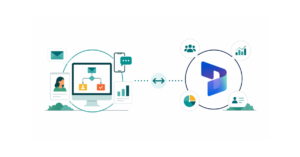
A marketing automation platform can sit alongside it and give marketers a purpose-built environment for campaign execution while exchanging the information both systems need.
Dynamics can manage accounts, contacts, opportunities, sales activity, and other CRM data.
Marketing can use that data to build audiences, personalize communications, automate journeys, score engagement, and measure campaigns.
Relevant marketing activity can then flow back into Dynamics so sales retains visibility into the customer relationship.
The goal isn’t to separate marketing from CRM data.
It’s to give marketers a way to use that data without requiring them to become CRM administrators.
Your Marketing Platform Should Give Marketing More Independence
Marketing automation should automate more than customer communications.
It should make the marketing team easier to operate.
If routine campaigns constantly require technical tickets, administrator intervention, custom workarounds, or specialized knowledge, it’s worth asking whether the technology fits the team responsible for using it.
Dynamics 365 Customer Insights – Journeys offers extensive capabilities, and for organizations with the right requirements and resources, that sophistication may make sense.
For others, a marketing automation platform that integrates closely with Dynamics while giving marketers more control over day-to-day execution may be a better operational fit.
Give Marketers More Control Without Giving Up Dynamics 365
The emfluence Marketing Platform integrates directly with Microsoft Dynamics 365, giving marketers access to CRM data without requiring Dynamics to become their day-to-day marketing workspace.
Marketers can build segments, create email and SMS campaigns, automate customer journeys, manage forms and landing pages, and use CRM data for personalization while Dynamics remains the system your sales team already knows.
The result is a connected CRM and marketing ecosystem with fewer barriers between an idea and an executed campaign.